


Firstly, let’s briefly clarify what Broadcom does.
It designs custom AI chips and networking equipment for hyperscalers, alongside an infrastructure software business.
In easy words, think of Broadcom like this: You can’t see what they make, but without them, the internet wouldn’t work!
They design the specialized chips inside smartphones, Wi-Fi routers, and massive data centers that allow devices to communicate and stream data at high speeds.
They provide heavy-duty software (primarily through their VMware division) that helps large corporations, banks, and governments manage their cloud networks.
The stock has stagnated so far this year (only up 3.3%) while sales are on track to grow 66% in 2026 alone while earnings could nearly double.
So the question is: Can the next five years deliver enough growth to justify the price of $1.7T? To understand it we must look at the numbers.
What changed beneath the surface
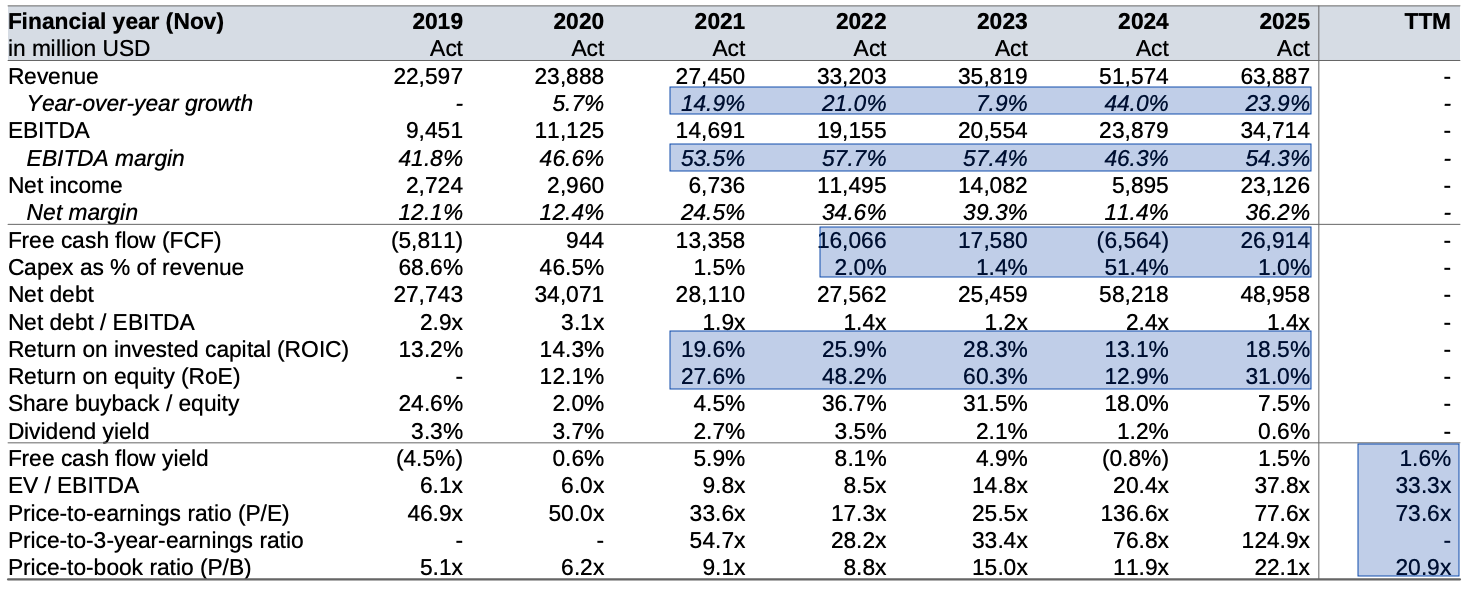
Broadcom’s revenue increased from $22.6bn in 2019 to $63.9bn in 2025. The VMware acquisition contributed significantly to the step-change in 2024, so the historical growth rate is not purely organic.
Operating margin (EBITDA) measuring the profitability of the core business has remained above 50%, an exceptionally high number.
Free cash flow scaled as the business grew. 2024 marks an exception as the company spent ~60bn on the acquisition of VMware.
ROIC and ROE measure the efficiency of each dollar spent. Values above 15-20% mark an outstanding business.
And what about 2026?
Q3 revenue rose 86% to $29.6bn. AI semiconductor revenue reached $16.7bn, up 221%, while infrastructure software grew 29% to $8.8bn. That means AI now accounts for more than half of total revenue .
Profitability is keeping pace. Operating income increased 171% to $16.0bn, while free cash flow nearly doubled.
So in 2026 we expect sales to be up 66% and FCF and net income to double compared to 2025 numbers backed by Q3 reports and Management guidance.
The growth is real. The duration is uncertain.
The AI outlook is even more aggressive. Management now expects approximately $115bn of AI chip revenue in FY2027 and $230bn in FY2028. The opportunity is substantial. Hyperscalers are building custom accelerators to reduce dependence on general-purpose GPUs and optimize their own AI workloads. Broadcom benefits from both the chips and the networking infrastructure connecting them.
The risk is concentration. A small number of customers account for a large share of AI demand, and their spending depends on the economics of AI infrastructure. Product transitions, competing chip designs and changes in customer spending (capex) can materially affect future growth.
The software business adds recurring revenue and stability, but it cannot make the semiconductor cycle disappear. If you look at the financial metrics table again you can observe substantial swings in the almost all metrics.
Before we buy or sell we must consider that uncertainty.
The pattern at work
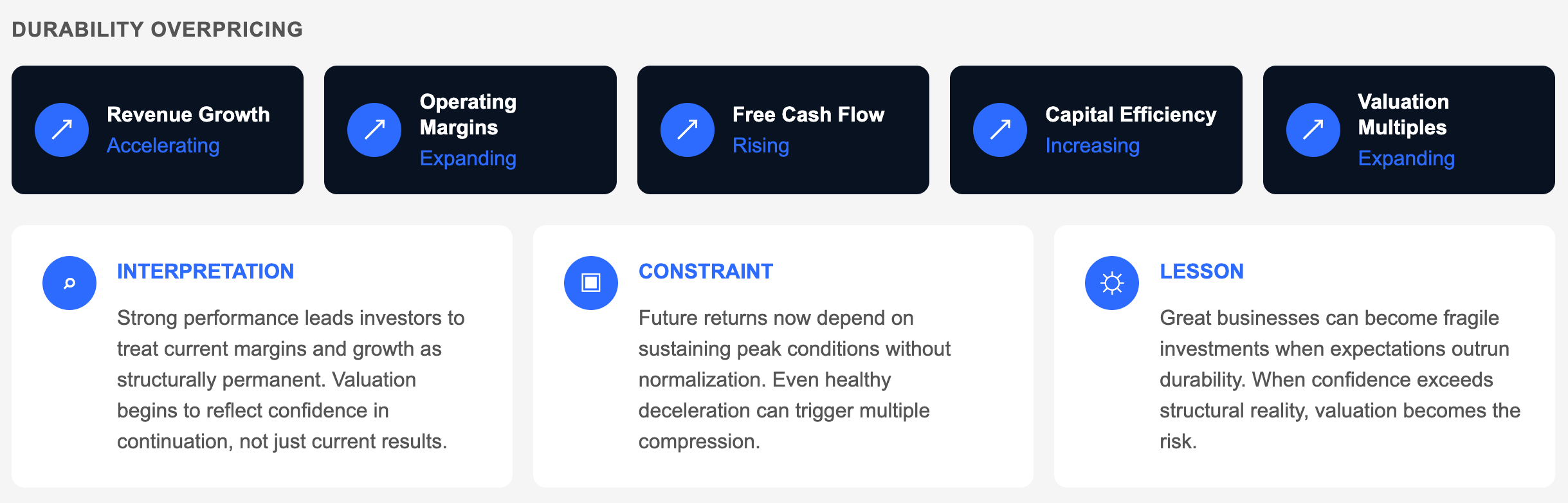
Equity analysts often call that Durability Overpricing - a financial pattern where cyclicality is underestimated and a profitable stock trades at a price that assumes endless growth.
What growth does the valuation require?
The historical valuation ratios make Broadcom look extremely expensive: approximately 74x earnings and a 1.6% FCF (Free cash flow) yield. But those figures do not reflect the full 2026 earnings transformation.
We should give the company credit for its strong 2026 year. Adjusting the historical multiples accordingly leaves us with a forward P/E of 37.9x and FCF yield of 3.5%.
Valuation looks reasonable now given that industry average of ~25-35x PE and 3-5% FCF yield.
Now assume an investor wants a 15% annual return over the next five years. Also assume Broadcom matures and trades at 35x earnings or a 4% FCF yield in 2031 (still premium valuation assumptions).
Even after that and the strong 2026 year, investors still need another five years of roughly 17–18% annual profit and cash-flow growth to earn 15% annually.
Is that achievable? Consider the following:
Management’s AI outlook provides a credible path to substantial growth through 2028.
The business requires strong growth to continue through 2031, when the business is much larger and the current AI investment cycle may be more mature.
History has shown that limited visibility and volatility have shaped financials
Customer concentration and dependencies on their capital spending decisions has a huge impact.
The bear case does not require AI demand to collapse. Growth could simply normalize earlier than expected. A business growing earnings at 10% rather than 17% can still be excellent, but it would struggle to support a 15% stock return.
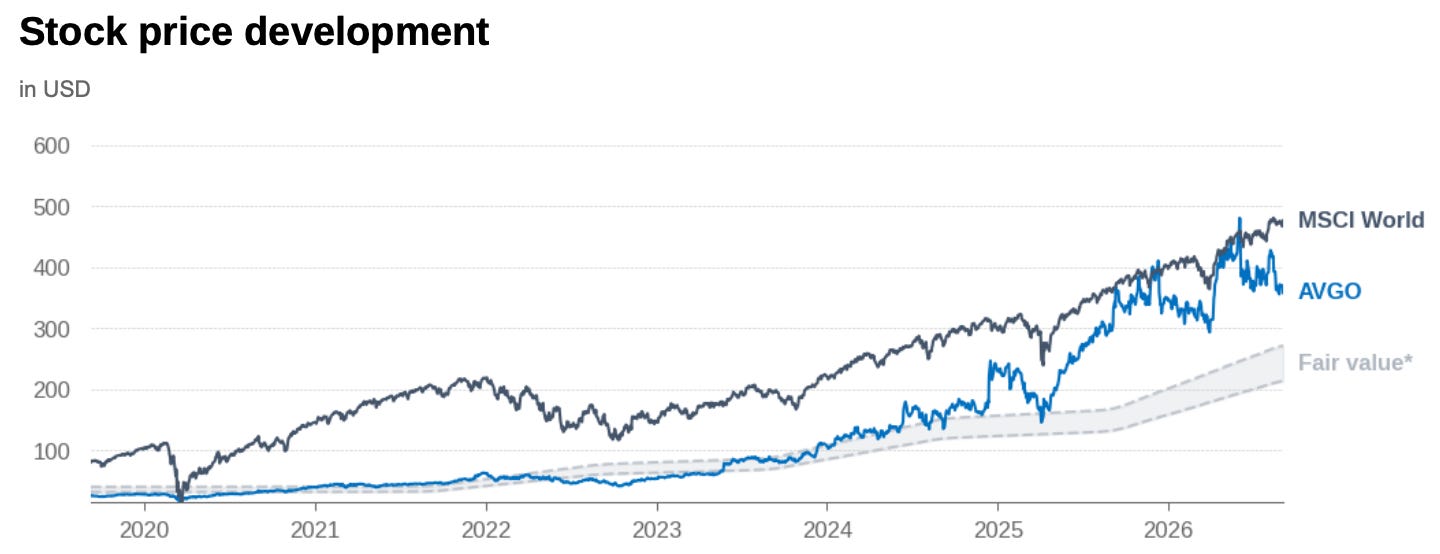
Based on current metrics Broadcom stock trades above its fair value but the strong 2026 guidance and early (unaudited) results support the valuation.
The insight & verdict
Broadcom’s latest results justify a much higher earnings base than the historical X-Ray suggests. Ignoring that would underestimate the business.
But giving full credit for 2026 does not eliminate the valuation risk. It moves the question forward: can Broadcom compound an already much larger earnings base at close to 20% for another five years?
I would not call the stock a SELL simply because that hurdle is high. The AI opportunity may be large enough to support it. But I would also not call it a BUY without a greater margin of safety. HOLD is the appropriate verdict here.
How to understand stocks in seconds:
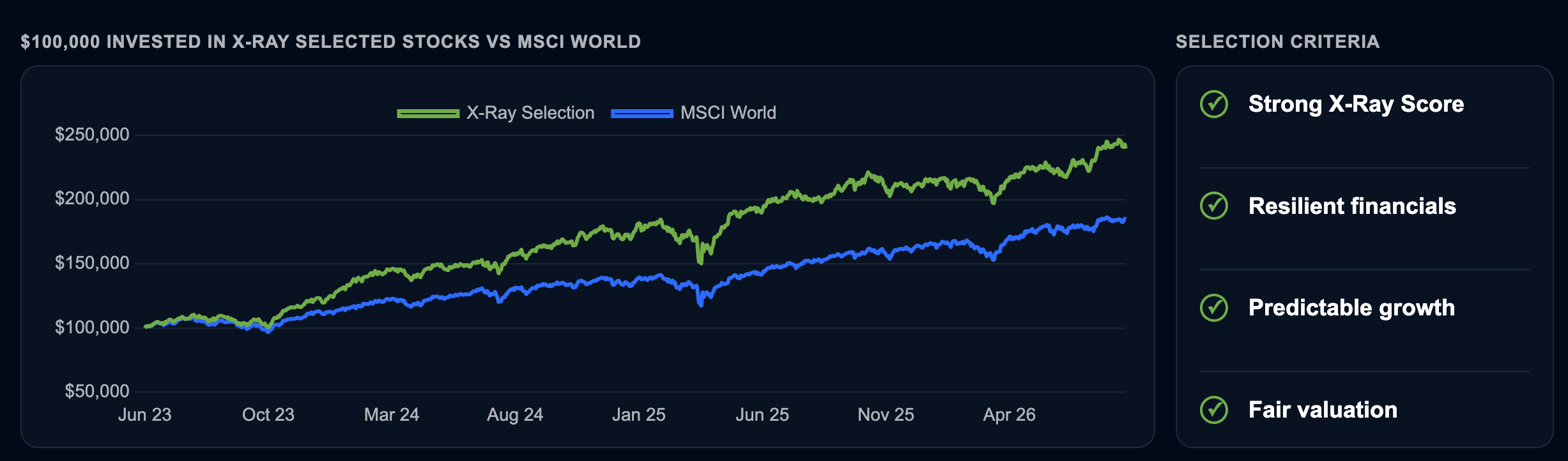
As an equity analyst I built The Financial X-Ray for my subscribers - a platform covering 800+ stocks. It serves as your digital private analyst to evaluates strengths, weaknesses and prices in seconds. Stocks with a strong X-ray quality score have performed exceptionally well since inception. Goal is to find quality at a reasonable price.
Any questions you may have, feel free to reach out.
Thanks for reading.
I keep wondering if the VMware software side can actually cushion the blow if the semiconductor cycle hits a soft patch, or if it just adds to the complexity?
Agree the print’s FCF was excellent — the valuation still needs the multi-year AI guide to convert into durable cash. $30 FY28 EPS needs almost all of the $230bn AI number, and Anthropic/OpenAI financing + power sit inside that. I underwrite nearer ~$23. Fuller take: https://substack.com/@frontiersignaltech/p-214060869