


In this article I stress test the investment conclusion of my fully automated stock analysis tool (The Financial X-Ray): Current X-Ray rating MEDIUM = HOLD.
In order to derive a fair value we must first look at the financials.
What changed beneath the surface
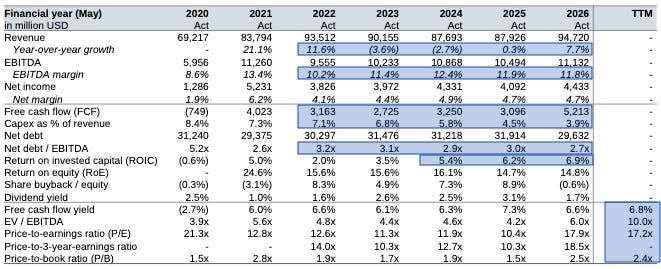
The strongest part of the FedEx story is cash generation. Free Cash Flow (FCF) surged 68% over the last year - a significant increase given the prior years range of $3-4bn.
FedEx did not become 68% more profitable. Free cash flow measures the money freely available to the business to pay shareholders. It is the amount generated by operating activities less investment spending (CAPEX).
A meaningful part of the cash-flow improvement came from spending less on the network. Capex fell to 4.0% of revenue, the lowest level in FedEx’s history. Investors should always favor a consistent evolution of this ratio (see metrics table).
FedEx has been simplifying its network, retiring aircraft and cutting structural costs. Management exceeded its $1bn transformation-related savings target in FY2026. Lower capital requirements could therefore represent a genuinely more efficient business.
But capex cannot keep falling indefinitely. Future FCF growth will increasingly need to come from higher operating profits.
And that is where the story becomes less convincing.
The latest Quarter shows the weakness
The latest quarter (fiscal year ended May 2026) showed how sensitive the business reacts to changes in the cost structure
FedEx generated $25bn of Q4 revenue, up 13%. Yet GAAP operating income fell from $1.8bn to $1.6bn, pushing operating margin down.
Demand wasn’t the problem. At Federal Express, package revenue increased 13%. U.S. domestic package yield increased 10%, while international priority yield increased 16%. FedEx was moving more packages and earning considerably more per package.
Costs simply moved faster.
Purchased transportation increased 15%, salaries and benefits 11%, and fuel expense jumped 66% from $864m to $1.4bn.
That is the weakness of a 10–12% EBITDA business. A relatively small change in costs can consume a large portion of operating profit.
FedEx’s returns on capital are moving in the right direction. ROIC has recovered from roughly 2% in 2022 to 6.9% in 2026, while ROE is around 15%. That matters because FedEx is generating better returns while reducing the capital required by the network.
There is genuine operational improvement underneath the numbers.
The pattern at FedEx
FedEx comes close to Cash Conversion Illusion or a valuation comfort trap, but it isn’t a textbook example.
Revenue: rising but volatile
Operating margins: flat but low
FCF: Increasing (through lower CAPEX)
Capex: Lowest % of revenue in company history
ROIC: Improving
Valuation attractive
Is FedEx cheap enough?
At roughly 17x earnings and a 6.8% FCF yield, FedEx doesn’t require extraordinary growth to justify its valuation.
That is attractive.
Management expects calendar 2026 revenue to grow approximately 11%, with adjusted EPS expected to decline by 5%.
But cheapness has to be considered alongside predictability.
FedEx operates an enormous physical network with aircraft, vehicles, facilities and hundreds of thousands of employees. Fuel prices, wages, transportation costs, trade policy and volumes can all move faster than the company can reprice its services.
Q4 demonstrated that risk in real numbers and the outlook shows that margin pressure is real.
13% revenue growth still produced lower operating profit. That makes a 6.8% FCF yield less compelling than the same yield from a business with 25% margins and low earnings volatility. Worth mentioning here is the elevated Net debt / EBITDA ratio near 3x - banks usually favour a value below 1.5x. The ratio is an indication for financial flexibility.
If you invested in FedEx stock today and expected a 10% return on your investment for 5 years, net income as well as free cash flow would have grow by ~7% per year in order for the stock to trade at slightly less depressed earnings multiple of 20x and a 6% FCF yield.
Now look at the history, we said margins are fairly stable (efficiencies offset cost explosion) but revenue fluctuates. Over the past 6 years revenue grew by an average of 2-3% or 4-5% including the pandemic year 2020.
If growth remains close to historical levels and margins remain resilient your expected annual return is roughly 7%.
Higher returns are only possible if growth picks up significantly and margins expand - but that is less likely to happen.
So where does it leave us?
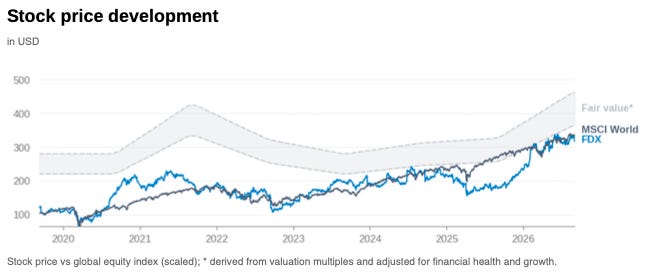
Attractively valued yes, enough strength and resilience to outperform no. That’s exactly what the Financial X-Ray shows you by adjusting dozens of metrics and deriving a fair value band
The insight
FedEx is becoming a better business.
Costs have been removed, capital intensity has fallen, ROIC has improved and cash generation is stronger. The current valuation does not demand heroic growth.
But investors should be careful extrapolating the 68% increase in FCF.
Capex is already at a historical low. Margins remain thin. And Q4 showed that fuel and other operating costs can quickly overwhelm otherwise healthy revenue growth.
That leaves FedEx in an unusual position:
The valuation looks cheap and the improvement is real. The question is whether the improvement is resilient enough to deserve a higher valuation.
For now, I don’t think the evidence is strong enough.
Verdict: Hold and in line with the Financial X-Ray.
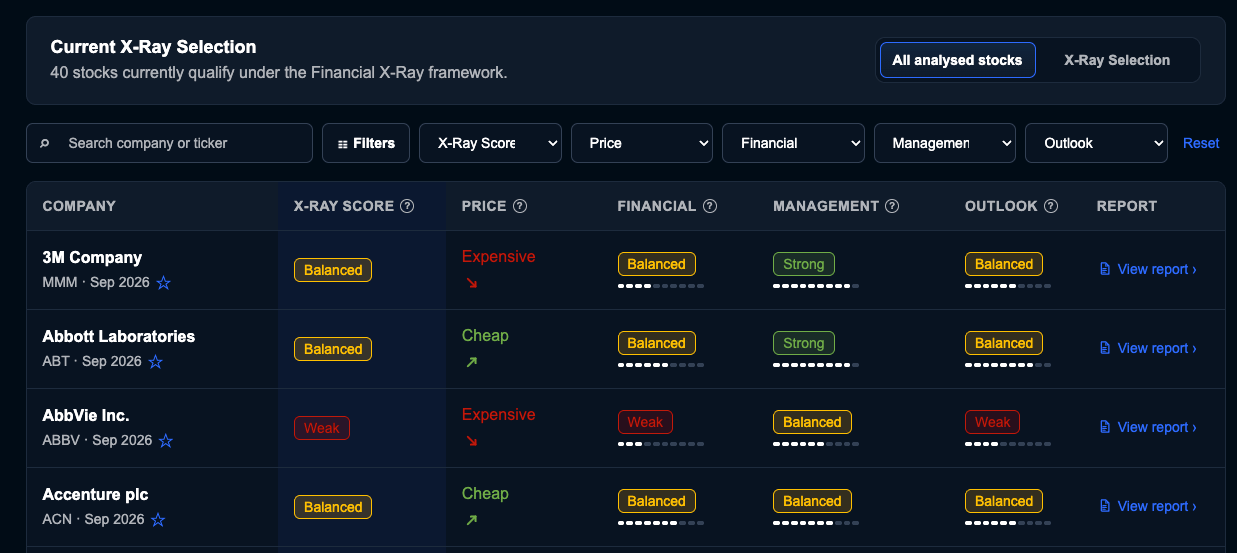
The X-Ray is the digital analyst I built, it helps me see strengths and weaknesses in relation to fair value in seconds. As a free subscriber you can use it as well. It is available though my website.
Thanks for reading!