


SAP has rallied roughly 20% over the past month. After a move like that, the natural reaction is to wait for the next pullback. But price alone tells us very little about whether a stock has become expensive.
So the question of this article is simple:
Has SAP’s share price run ahead of the business or are the fundamentals strong enough to justify further upside?
What stands out in the numbers?
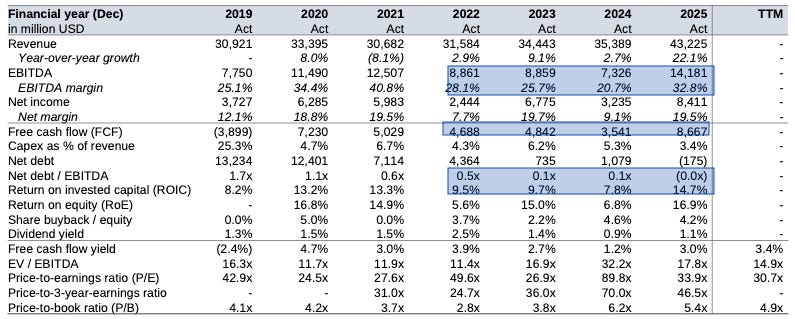
Three things make SAP’s financial profile particularly attractive.
Profitability. EBITDA margin has moved from roughly 23% in 2021 to around 32% today, placing SAP toward the upper end of the broader software industry.
Capital efficiency. The X-Ray shows ROIC rising from 8.2% in 2019 to 14.7% in 2025. That’s important: SAP isn’t simply investing more to grow; the returns generated on that invested capital have improved substantially beyond the cost of capital. In easy terms: that is value creation at an efficient level.
Cash generation. SAP expects free cash flow to grow by 21% in 2026. Combined with effectively no net debt at the end of 2025, that gives SAP considerable flexibility to invest in AI and cloud, make acquisitions, buy back shares and return capital without stretching the balance sheet.
High margins, improving returns on capital, growing free cash flow and little financial leverage.
The cloud transition is working
SAP is no longer primarily the traditional licence-and-maintenance software company many investors still associate with the name.
In Q2, cloud revenue reached €6.3 billion, up 22%, while Cloud ERP Suite revenue grew even faster at 25%. Cloud now represents roughly 64% of SAP’s quarterly revenue, compared with a shrinking contribution from traditional software licences and support.
That’s important because SAP is deliberately moving customers from licences and on-premise software toward recurring cloud subscriptions.
Traditional software support revenue fell 8% in Q2, while licence revenue fell 32%. This isn’t necessarily a sign of deterioration, it is increasingly the consequence of customers moving onto SAP’s cloud products.
The current cloud backlog (the contracted cloud revenue that has not yet been recognised) reached €22.9 billion ($26.3 billion), up 27%.
That gives SAP something investors should value highly: visibility. A meaningful part of future cloud growth isn’t merely management ambition; customers have already signed contracts for it.
And there is still runway. Management expects cloud revenue to reach €25.8–26.2 billion in 2026, up 23–25%, while total revenue should grow at roughly the same 10.6% rate as 2025 before accelerating again in 2027.
The next step is turning that growth into profitability.
SAP expects operating expenses in 2027 to grow at only 80–90% of the rate of revenue growth, helped partly by efficiency gains from using its own AI products internally. In simple terms: margins are expected to expand.
That’s the first reason I’m not particularly worried about the recent rally. The growth story still has numbers behind it, and the financial benefits of the transformation may not yet be fully visible.
Behind the paywall I’ll reveal the following:
Is 30.7x TTM earnings, 14.9x EV/EBITDA and a 3.4% free-cash-flow yield too much to pay? (Example calculation and visible fair value analysis)
What happens if the legacy software segment breaks?
And are we late to the party?