


American Express makes money every time its customers spend, charges annual card fees and earns interest when customers borrow. Customers are rewarded with Amex points that can be spent in a lifestyle world for groceries, holidays or consumer goods.

Effectively, American Express combines payment solutions, financing and consumption through its partnership network. That’s a strong moat. To determine whether or not the stock is a buy we have to look deeper.
What changed beneath the surface
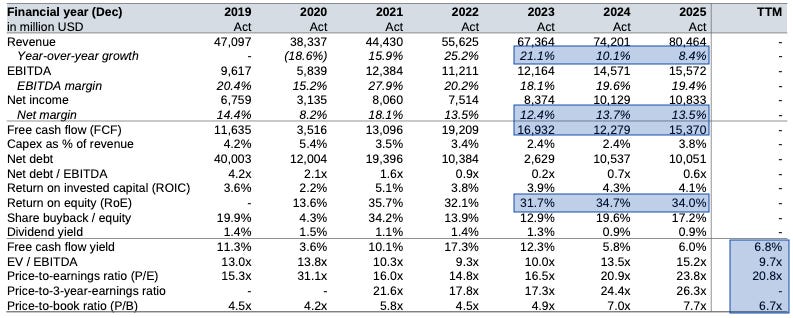
At first we must clarify an important distinction. American Express cannot be compared to Visa or Mastercard as it also operates as a bank that assumes credit risk. Consequently we have to take a hybrid approach that evaluates banking and industrial metrics simultaneously.
Growth: American Express has grown considerably faster than a mature financial company normally would. Revenue increased from $47.1bn in 2019 to $80.5bn in 2025.
Excluding the pandemic disruption, growth remained above 8% every year. That matters because Amex is already a huge business: sustained high-single-digit growth at this scale is evidence that the franchise is still expanding rather than merely protecting its existing customer base.
Growth above 20% in 2022-23 shows evidence of inflation resilience where customers spent right through inflation and Amex benefiting accordingly.
Profitability has kept pace. Net income reached $10.8bn in 2025, versus $6.8bn in 2019. That’s a consistent growth of 8% which is high for Amex hybrid business model.
More useful for a financial company is ROE which measures how effective the company generates profits on the shareholder capital. American Express has produced roughly 32–35% ROE since 2022 - a very strong return.
FCF reached $15.4bn in 2025, while net debt/EBITDA was only 0.6x. Those numbers look attractive, but Amex is a bank holding company. Deposits, lending and debt are part of how it operates. Conventional FCF, EBITDA and net-debt ratios therefore tell us less than they would for industrial or tech companies. So we we put a little less weight on these metrics.
Instead, we need to look at the credit book.
And that is where the investment case gets stronger.
The bank inside American Express looks healthy
Q2 revenue increased 10%, while billed business (the amount customers actually spent on Amex cards) increased 9%. Card balances and other loans grew 8%.
Normally, growing lending deserves scrutiny. More loans can generate more interest income today while creating credit losses tomorrow. That isn’t what the current numbers show.
The technicalities: The 30+ day delinquency rate fell from 1.3% to 1.2%. Principal write-offs remained at 2.0%. Credit-loss provisions actually declined 23%. And Amex maintained a 10.4% CET1 capital ratio, inside management’s 10–11% target range.
In simple terms: Amex is lending more without yet seeing customers struggle more to repay it.
The card franchise may be even more interesting
The quality of American Express isn’t simply that people use its cards.
It is who uses them and how much Amex can earn from them.
Average spending per proprietary card increased 6% in Q2. Average annualized fee per card increased 12%, from $117 to $131. Net card-fee revenue increased 15%.
Amex is therefore getting two forms of growth from the same franchise: customers are spending more, while the company is collecting more membership revenue per card.
But there is a cost!
Card Member services expense jumped 50% in Q2 as customers used more benefits and Amex expanded its Platinum offering. That led to total expenses growing at 12%, while revenue only grew at 10%.
Premium customers are valuable but keeping them loyal isn’t free.
The pattern in a nutshell
There is no clear structural distortion case observable.
Instead, American Express requires a hybrid analysis of corporate signals and banking signals.
Revenue & net income growth: ~8–10% above sector but slowing
FCF: strong vs peers but volatile
Capital efficiency (RoE): strong
Capital base: strong with CET1 >10% (regulatory metric)
Valuation metrics: attractive
The corporate numbers say the business is profitable.
The banking numbers tell us whether those profits are being created by taking excessive credit risk. Right now, they aren’t.
Why investors may misread the valuation
American Express trades at roughly 21x TTM earnings, compared with almost 24x based on 2025 earnings and based on an average of 20x over the past 7 years. Its FCF yield is around 6.8%.
Those numbers look inexpensive for a company producing ~10% revenue growth and >30% ROE. But comparing Amex directly with asset-light payment networks would be a mistake.
Amex deserves a lower multiple because it takes credit risk. A recession can simultaneously reduce card spending and increase customer defaults. Mastercard and Visa don’t carry that risk to the same extent.
A dividend discount model (DDM) is the most appropriate model to value American Express. Assuming an annual net income growth of 8-9% p.a (in line with history), a CET1 ratio > 10% (regulatory requirement), a discount rate of 8% (corresponding to it’s beta slightly above 1) yields a fair value of $ 220bn while the business is currently worth $ 225bn.
So does the current price level sufficiently compensates investors for the additional credit risk?
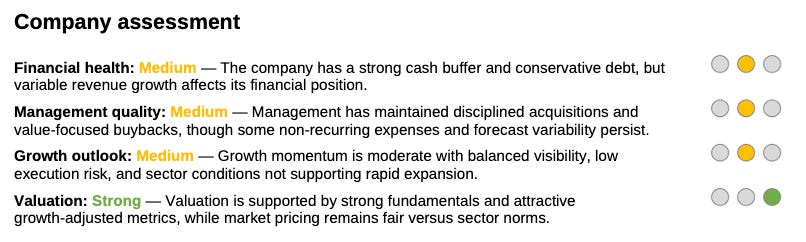
Today, the evidence says yes but not overwhelmingly so. The Financial X-Ray supports the results from the DDM above by taking the metrics discussed herein and by adjusting the valuation multiples accordingly. The result is displayed visually.
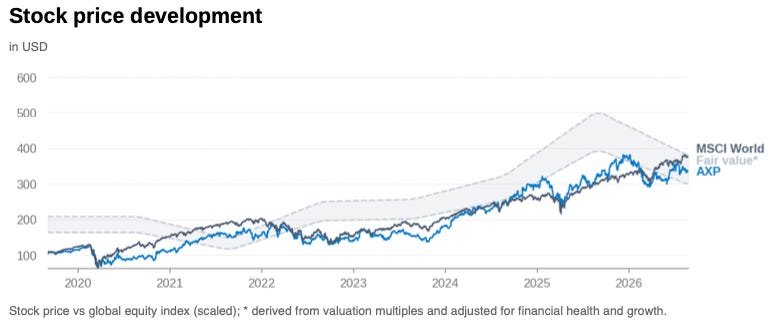
A transparent view on what the X-Ray does can be found on my website where I cover 800+ stocks using the exact same framework to see strengths and weaknesses in seconds.
The insight
American Express looks like a Buy, but not a deep-value one.
The investment case rests on an unusual combination: roughly 10% revenue growth, 36% ROE, increasing card spending, rising membership fees and currently healthy credit quality.
The risk is equally clear. Expenses are growing quickly, the company carries consumer credit risk, and its premium customer economics depend on continuing to offer benefits customers actually value.
The attraction is that investors currently get some of the economics of a premium payments franchise without paying a premium payments-network valuation.
At today’s price, that looks attractive enough.
Disclaimer: This is not investment advice to buy sell or hold any security.
Thanks for sharing this awesome deep dive on American Express! Seeing their revenue climb from $47.1 billion in 2019 to $80.5 billion in 2025 while keeping a solid 32-35% ROE proves how strong their premium credit model really is. It’s a great reminder for young investors that understanding credit risk matters just as much as picking cool brand names.
I have never had possession of an American Express card. However it must feel a little good to the ego driven to pull one out at a bar or restaurant. I’m sure this type of demand is not going away soon. So I think it’s safe to say they have a pretty enduring moat with the rich and famous. My concern is, can it be used extensively across the various establishments. or are the places where it is accepted shrinking?