
Lockheed Martin’s Stock Rally Over Iran War Is Not Sustainable – The Business Faces a Quiet Deterioration in Its Economics
For many investors, Lockheed Martin represents stability. But a closer look at the financials suggests the engine behind those returns may be shifting.

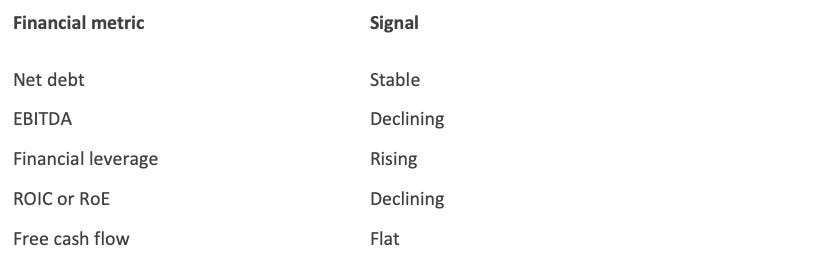
These signals rarely move in isolation. When read together, they often reveal structural dynamics beneath the surface of a business. (Full framework)
What changed beneath the surface
The revenue story is relatively straightforward. Demand for defense systems remains stable, and the company continues to benefit from long-term contracts and government spending priorities.
That stability supports steady growth and reliable cash generation.
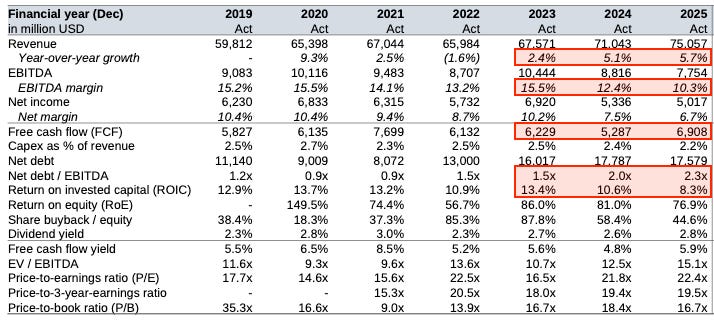
However, the profitability of the business has gradually softened. Operating margins have trended lower in recent years, suggesting that the company is keeping less profit from each dollar of revenue than it used to. Net margins show a similar pattern.
Another signal points in the same direction: capital efficiency. Returns on invested capital have also declined, which indicates that new capital deployed into the business is generating somewhat lower returns than in the past.
But when viewed together, these shifts suggest that the operating engine of the company has become slightly less efficient over time and as operating margins soften, financial leverage gradually increases.
That combination creates an interesting financial dynamic. Leverage Drift (see full pattern here).
The pattern at work
Why investors often misread this phase and what it implies for valuation
Investors tend to focus on what is most visible: stable revenue, strong cash flow and consistent shareholder returns.
Lockheed Martin still delivers on all three, which supports its reputation as a dependable long-term compounder.
But valuation reflects more than stability. It depends on how growth, margins, cash generation and capital efficiency evolve over time.
If operating efficiency declines, long-term earnings power can grow more slowly than investors expect. Rising leverage adds another constraint by reducing balance sheet flexibility.
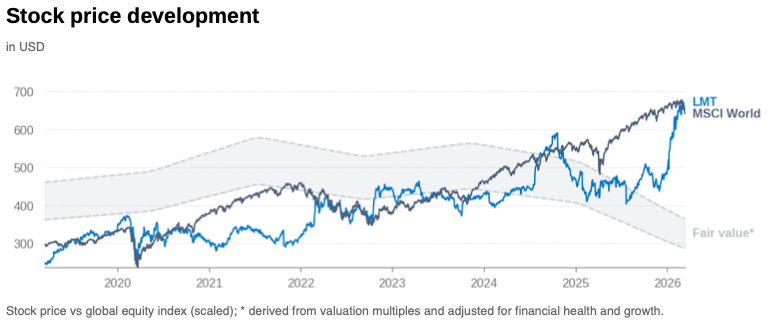
The declining fair value band reflects this shift: stable demand and cash flow are no longer fully offsetting weaker profitability, lower capital efficiency and higher leverage.
With the stock now trading above that range, it suggests that future returns may depend more on operational improvement than on financial engineering.
The insight
Lockheed Martin remains a dominant defense contractor with durable demand.
But there is a subtle deterioration beneath that stability.
Margins are shrinking, capital efficiency is weakening, and leverage is rising.
The business still generates strong cash flow, yet the underlying economics are becoming less efficient. The direction of the stock price does not reflect that development.
A quick glimpse on Management quality reveals several encouraging signals. The company has historically been disciplined with acquisitions and has generally executed buybacks thoughtfully. Forecasts have also been relatively reliable.
Still, even well-managed companies can experience periods where the underlying economics of the business evolve.
For investors, the takeaway is clear: the company is stable, but the quality of the operating engine is slowly eroding.
Disclaimer: This analysis highlights one financial dynamic observed across companies.
The Financial X-Ray evaluates financial health, growth, management quality and valuation together – revealing how individual metrics behave when viewed as a system.
→ Explore the Financial X-Ray framework
This publication is for educational purposes only and reflects analysis of publicly available financial information. It is not investment advice.
Definitely am not an expert on defense companies but I used some pretty basic assumptions and got relatively low returns from LMT. Company might be a good company but might be best to pass on an investment into them today until they trade at a slightly lower valuation. Will definitely look into them more now!
Thanks for the great piece.
Defense stocks soften on peacetime lack of re-stocking demand. This is the corporate incentive to support (and lobby for) warhawks in Congress and the Administration.
Wars not only increase demand for ammunition - which is typically higher margin than the base systems that use the ammunition, and for the same reason that game software is higher margin than the gaming system - it increases demand for new systems.
The cynical observer of the current insane conflict with Iran does not see it as a strategic blunder, nor perceive the potentially decadal quagmire as a challenge to the Military Industrial Congressional Complex. On the contrary, we see it as the standard operating procedure: produce panic by exhausting our ammunition stocks, which leads to political pressure to re-stock and concomitant pressure to "invest" (steal public monies) in new industrial capacity so we can re-stock "fast enough" so we don't feel vulnerable.
Take note; the people running this scam do not feel vulnerable. They run this scam because they are quite certain of their immunity to consequences. They will not be on the receiving end of a hellfire missile in their penthouse apartment. They will be on the receiving end of significant campaign finances and Swiss bank account deposits.
The public perception of vulnerability, produced BY their entry into an illegal and nonsensical war of choice, and amplified continuously by the media and the pundits alike, is the mechanism by which those funds are extracted.
Oh, and never forget William Blum:
"No matter how paranoid or conspiracy-minded you are, what the government is actually doing is worse than you imagine."