
Looking for Value in Large Caps? Look Closer.
Three companies with attractive upside – but each comes with a catch investors cannot afford to ignore.

The market loves certainty.
A strong balance sheet, recurring cash flow, dominant market positions, and years of successful execution usually earn a company a premium valuation.
Yet investing becomes more interesting when a business has many of these qualities while still carrying a meaningful uncertainty that divides investors.
That uncertainty can take many forms. It might be dependence on a single growth engine. It might be exposure to economic cycles. Or it might be a business model that appears stronger than the market believes, but still faces questions that cannot be dismissed.
In this week’s Financial X-Ray article, we examine three companies that combine attractive upside potential with genuine risks. None of them are broken businesses. In fact, all three possess qualities that many investors actively seek: strong cash generation, established competitive positions, and proven management teams.
The question is whether the market is overestimating the risks – or underestimating them.
Using the Financial X-Ray framework, we break down the strengths, weaknesses, valuation signals, and long-term outlook for each company to determine whether today’s uncertainty represents an opportunity or a warning.
1. NVIDIA – The AI leader increasingly dependent on a single engine
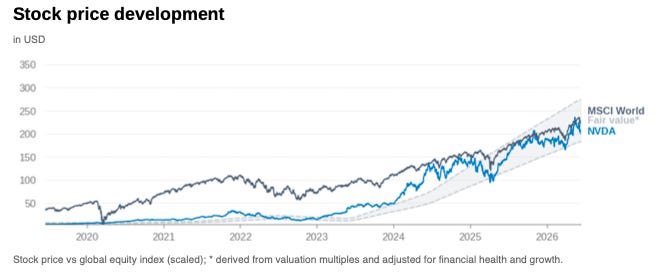
At first glance, NVIDIA looks almost impossible to criticize.
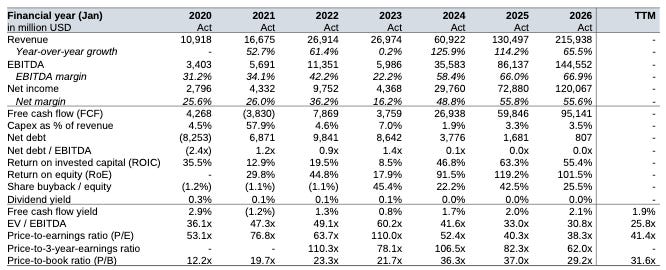
Fundamentals remain incredibly strong:
Revenue increased from $27 billion in 2023 to more than $216 billion in 2026. EBITDA margins (the profitability of the operating business) expanded from 22% to nearly 67%, which is way above peers. Net income exceeded $120 billion while the company moved to a virtually debt-free balance sheet.
Few companies in modern history have compounded value at a similar pace.
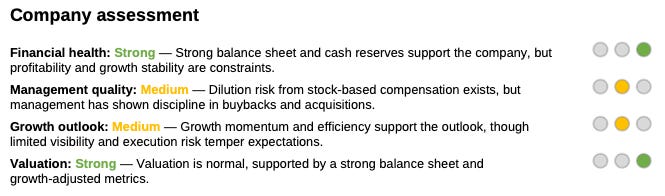
The Financial X-Ray highlights strong financial health, strong cash generation, strong profitability, and attractive growth-adjusted valuation metrics. Revenue, EBITDA, and free cash flow have all improved dramatically in recent years.
What investors may be missing is that NVIDIA’s success has become increasingly concentrated.
Approximately 90% of revenue now comes from the Data Center segment. Gaming, once the company’s core business, contributes less than 10% of sales.
The opportunity is obvious. If AI infrastructure spending continues expanding, NVIDIA remains one of the most powerful beneficiaries in global markets.
The risk is equally obvious. A company generating nearly all of its growth from a single end market becomes vulnerable to spending slowdowns, competitive pressure, customer concentration, and geopolitical restrictions.
The market currently assumes AI investment remains exceptionally strong for years to come. That may happen. But if expectations prove even slightly optimistic, valuation multiples could compress much faster than operating performance.
NVIDIA is a world-class business with strong fundamentals trading at a fair value. The debate is whether the fair value expansion can continue if the market slows down. As of today, investors buy quality at a reasonable risk.
What metrics do we look at in equity analysis?
A deep understanding of a stock can be gained when we look at financial metrics over time assessing stability, level and trend. The Financial X-Ray does exactly that and lets you screen for analysed conclusions instead of raw number.
