
ServiceNow – When Hypergrowth Becomes Healthy Growth
ServiceNow’s growth is slowing. That’s the headline investors focus on. But beneath the surface something unusual is happening. The business is getting stronger as the market becomes more cautious.

These signals rarely move in isolation. When read together, they often reveal structural dynamics beneath the surface of a business. (Full framework).
What changed beneath the surface
ServiceNow remains one of the strongest enterprise software businesses in the market.
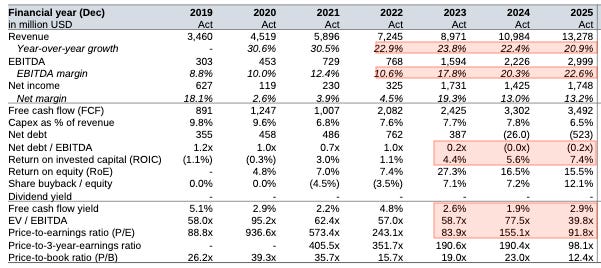
Revenue growth is still exceptional by large-cap standards, remaining above 20 percent annually. Sustaining that level of expansion at scale reflects strong demand for workflow automation and enterprise digital transformation.
At the same time, profitability has improved significantly. EBITDA margins have expanded as the platform scales and operating leverage materializes. The company increasingly benefits from the typical software dynamic: once core infrastructure and development costs are absorbed, incremental revenue becomes more profitable.
Cash generation follows the same direction. Free cash flow has increased meaningfully, reinforcing the financial resilience of the business model.
The balance sheet has strengthened as well. Net debt has declined, leaving the company with substantial financial flexibility.
In other words, the economic quality of the business is improving.
But the nature of growth is gradually changing.
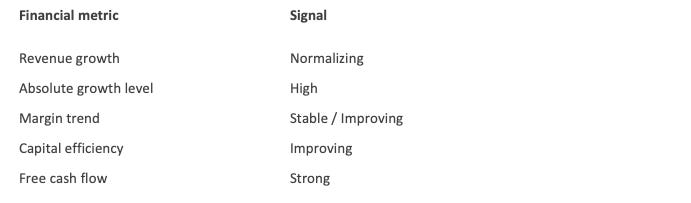
Revenue expansion is normalising from earlier hyper-growth levels as the company becomes larger. That shift is natural for a platform reaching greater scale, yet it often changes how investors interpret the story.
Markets tend to focus heavily on the direction of growth, sometimes overlooking simultaneous improvements in profitability, capital efficiency, and cash generation.
This creates a subtle tension: the fundamentals continue to strengthen even as the headline growth rate moderates.
This situation reflects a recurring financial dynamic:
The Growth Normalization Paradox.
The pattern at work
See the full pattern explanation here.
Another element investors should monitor is management quality. Stock-based compensation remains relatively high and insider selling activity has been visible, introducing ongoing shareholder dilution. While common in the software sector, these signals suggest that capital discipline and incentive alignment will remain important as the company transitions from hyper-growth to mature scaling.
Why investors often misread this phase and what it implies for valuation
Investors often interpret slowing growth as a sign that a company’s best days are behind it. But that is not necessarily the case.
For companies like ServiceNow, some degree of growth normalisation is inevitable as the business scales. Maintaining revenue growth above 20 percent at this size is still an exceptional performance.
What matters is what happens at the same time.
Margins are expanding, free cash flow is rising, and capital efficiency is improving. These signals indicate that the economics of the business are strengthening even as growth becomes more sustainable.
This creates an important valuation dynamic.
Stronger profitability and cash generation support structurally higher valuation levels. But slowing growth typically leads investors to apply a narrower multiple range, reflecting the transition from hyper-growth to mature scaling.
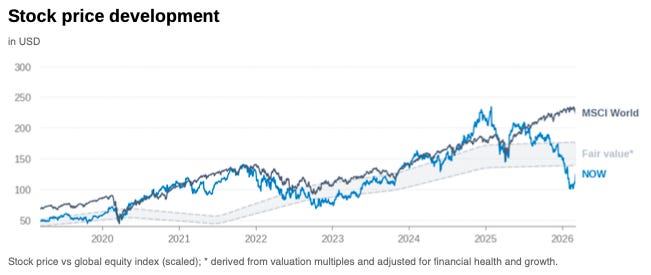
These interaction are captured in the fair value band.
In ServiceNow’s case, the market may have overreacted to the growth normalisation narrative. The recent decline pushed the stock toward the lower end of the fair value range even though the underlying financial signals continue to strengthen.
The key takeaway is subtle but important. Growth may be normalising, but the economic quality of the business is improving.
When those two forces collide, markets sometimes mistake healthy normalisation for deterioration.
The insight
ServiceNow is not a broken business. On the contrary, it remains one of the strongest enterprise software platforms in the market.
Revenue growth is still impressive.
Margins continue to expand.
Free cash flow keeps rising.
But the investment dynamic has changed.
The company is transitioning from hyper-growth to sustainable growth at scale.
That shift does not weaken the business.
It simply means that future returns depend less on rapid expansion and more on disciplined execution.
In this phase, the key question is no longer whether the company can grow.
The question becomes: Can it continue delivering results that justify already high expectations?
And this is where management quality begins to matter more.
Stock-based compensation remains elevated and insider selling has been visible, which introduces dilution risk over time. When growth naturally normalises, capital discipline and incentive alignment become more important drivers of shareholder returns.
Disclaimer: This analysis highlights one financial dynamic observed across companies.
The Financial X-Ray evaluates financial health, growth, management quality and valuation together – revealing how individual metrics behave when viewed as a system.
→ Explore the Financial X-Ray framework
This publication is for educational purposes only and reflects analysis of publicly available financial information. It is not investment advice.
Have you taken a look at TTD? It seems like what you're describing but at half the valuation.