
Snowflake Generates Cash. So Why Is It Still a Speculative Bet?
Free cash flow can overstate business quality when cash generation depends on shareholder dilution rather than operating profits.

Snowflake has become one of Wall Street's favorite AI infrastructure companies. Its cloud-native Data Cloud enables enterprises to store, organize and analyze massive amounts of data across different cloud providers – making it a critical layer for modern analytics and artificial intelligence applications.
Investors have rewarded that position with a premium valuation, betting that rapid adoption will eventually translate into exceptional profitability.
Let’s dive into it and see how snowflake performs under the Financial X-Ray - a structured lens to evaluate quality in seconds.

What changed beneath the surface
On almost every operating metric, Snowflake has delivered exceptional growth.
Revenue increased from $265 million to nearly $4.7 billion in just six years – equivalent to an annual growth rate of almost 60%. For context, most mature software companies grow between 10% and 20% annually, making Snowflake’s expansion extraordinary.
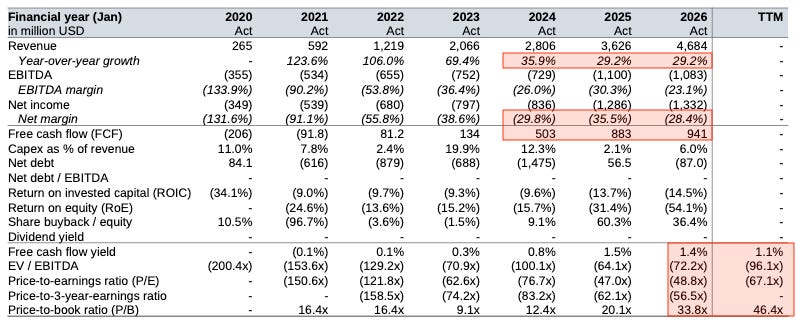
Free cash flow has also improved dramatically, rising from negative $206 million to almost $1 billion. At first glance, this suggests the business has become highly cash generative.
But the income statement tells a different story.
Despite almost $5 billion in annual revenue, Snowflake still reports negative EBITDA, negative net income, and negative returns on invested capital. A mature software business would normally convert this level of revenue into attractive operating margins and double-digit returns on capital. Snowflake has not yet reached that point.
This creates the central tension.
The cash flow statement appears exceptionally strong.
The underlying economics remain considerably weaker.
This is not an obvious financial pattern, it is an illusion of cash conversion.
The pattern at work
To determine whether the fundamentals shown in the table above reflect a healthy business, analysts must evaluate them together and over time.
Revenue growth = Extreme
Operating profitability = Still negative
Free cash flow = Improving strongly
Stock-based compensation = Very high
Capital efficiency (ROIC) = Still negative
Valuation = Premium
At first glance, these signals appear contradictory and this observation does not fit a textbook pattern.
How can a company generate almost $1 billion of free cash flow while still reporting large operating losses?
The answer lies in the construction of the cash flow statement.
Snowflake compensates many employees with stock rather than cash. Because stock-based compensation is a non-cash accounting expense, it is added back when operating cash flow is calculated.
Think about it this way: if a company pays your salary it incurs a cash outflow because that’s what you are paid (money). In order to avoid that outflow and keep the money inside the business, snowflake pays its employees with shares or the option to purchase shares at a lower price than the market price.
That way the company genuinely retains more cash today.
But existing shareholders pay for part of that cash through future dilution - if a company gives away more shares it is not creating wealth, it is deluting the existing equity.
The Financial X-Ray therefore separates reported cash generation from economic profitability.
Strong free cash flow alone does not necessarily mean the underlying business has become highly profitable.
That is why reading one financial statement in isolation can be misleading.
Why investors often misread this phase and what it implies for valuation
Many investors stop at one headline:
“$1 billion of free cash flow.”
The Financial X-Ray goes a bit deeper and answers the next question:
How much of that cash ultimately belongs to existing shareholders and how durable is that number?
Snowflake currently trades at approximately 67x earnings, nearly 100x EV/EBITDA, while its free cash flow yield is only about 1.1%.
Put differently, every $100 invested buys only about $1 of annual free cash flow today.
Investors therefore accept a very low current cash return because they expect Snowflake to become dramatically more profitable over time.
Another way to think about today’s valuation is this:
If Snowflake’s share price were to compound at 10% annually over the next decade - a number required to slightly beat the S&P 500 index – while eventually trading at a more mature software valuation of around 5% free cash flow yield, free cash flow would need to grow by roughly 28–30% per year for ten consecutive years.
That is an extraordinary requirement.
It assumes not only continued revenue growth, but also a successful transition from cash generation supported by stock-based compensation to durable operating profitability.
The investment case depends less on today’s free cash flow than on whether today’s accounting cash eventually becomes genuine economic earnings.
So what is a fair price to pay for Snowflake today?
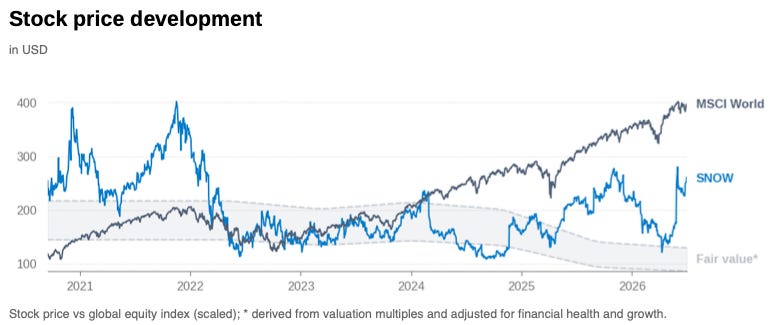
The Financial X-Ray helps you answer that question in minutes. It calculates a fair value range based on financial health and growth. With the stock currently trading significantly above that range, the market appears overly optimistic leaving little room for upside.
This level of understanding becomes visible when looking at the right metrics and the right interpretation. I cover more than 800 stocks on my website, to help you find the right investment.
The insight
Snowflake is not a weak business.
It is one of the fastest-growing software platforms in enterprise AI.
The Financial X-Ray simply highlights a distinction many investors overlook.
Cash flow and economic profitability are not always the same thing.
When free cash flow looks strong while operating profits remain deeply negative, analysts should ask where the cash is coming from and whether existing shareholders ultimately pay for it through dilution.
Sometimes the most important number is not the one that looks strongest.
It is the one that explains why.
If you enjoyed the article give me a thumbs up - it helps me to evaluate and improve my content. Thanks for reading.
Interesting article - SNOW is one of the positive regime companies in the Ps Index and the revenue story and engineering activity align perfectly. However, this is a good example of why multiple layers are important for equity analysis because the engineering signal aligns with part of the balance sheet but can't tell the whole story