


Vertiv is one of the less obvious beneficiaries of the AI boom.
The company supplies the physical infrastructure data centers need to operate (power management, cooling systems and related services). More powerful AI chips require more electricity and generate more heat, making this infrastructure increasingly important.
And that opportunity is already visible in Vertiv’s numbers. The company getting stronger.
What changed beneath the surface
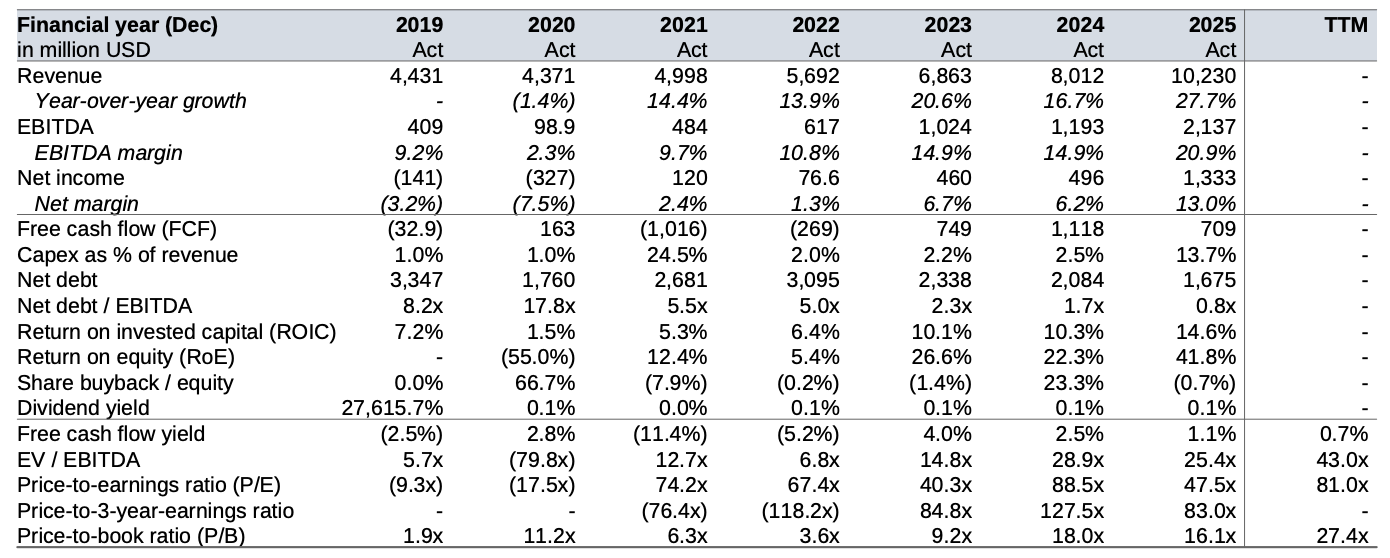
Revenue increased from $4.4 billion in 2019 to $10.2 billion in 2025, that’s an annualised growth of 15% and accelerating as spending on data centers increases.
EBITDA margin expanded from 9.2% to 20.9% which means that a much larger percentage of every revenue dollar now becomes operating profit. That’s a better improvement compared to peer companies.
ROIC reached 14.6%. The company is generating increasingly attractive returns on the capital required to grow the business. This is a strong sign of efficiency.
Net debt/EBITDA fell from 8.2x to 0.8x. Growth has therefore strengthened rather than stretched the balance sheet. A level below 2.0x is a solid basis for the sector.
Free cash flow reached $709 million in 2025, but fell from $1.12 billion in 2024. This is the one metric that initially looks out of place. Vertiv is spending aggressively to increase capacity. Recall that FCF = Operating cash flow - capital spending which rose above 13% of sales in 2025. The good news: Management now expects capital spending to be $550–570 million for the full year 2026, roughly 4% of expected revenue. (so we’re back on track).
Q2 confirms the acceleration
Q2 revenue increased 24.1%, from $2.64bn to $3.27bn and profit grew even faster.
Gross profit increased 37.7%, operating profit 44.2% and net income 53.5%.
That’s considerably more important than the headline revenue growth. And management raised its expectations again.
Vertiv now expects roughly $14 billion of 2026 revenue, about 31% organic growth, adjusted operating margins of 23.3–24.3%, adjusted FCF of $2.4–2.6 billion and net income of $2.3bn ($1.3bn in 2025).
Now, compare that to the table above. That is highly attractive.
The devil is in the detail
Don’t extrapolate the current Q2 free cash flow. Why? Because during the first half, free cash flow is artificially increased by deferred revenue of $1.8bn (money the company collected but without having delivered the product). Over the next two years Vertiv only expects deferred revenue of $0.6bn. So there will be no further large inflows of that kind.
Consequently I’d conservatively forecast 2026 FCF as ~1.6bn (H1 FCF) x 2 - 1.8bn deferred revenue = ~1.4bn rather than 2.4-2.6bn adjusted management guidance.
Management states the following:
“This is a forward-looking non-GAAP financial measure that cannot be reconciled without unreasonable efforts for those reasons set forth under “NonGAAP Financial Measures” of this release.”
That basically means there are unpredictable swings in working capital. This is part of the reason why financials must be evaluated on an annual basis and over time instead of in isolation.
The pattern I see: Durability Overpricing?
Vertiv currently has almost everything investors want:
Revenue growth ↑
Margins ↑
Free cash flow ↑
ROIC ↑
Leverage ↓
That combination deserves a premium.
But what growth does the market currently expect given a market cap of $95bn? How do margins and cash flow have to develop to justify the price? Is Vertiv a clear BUY after the 35% drop?
That’s what I’ll reveal behind the paywall. The insights I am giving you in this article are detected by an automated digital analyst, the Financial X-Ray that recommended to BUY Vertiv in June 2023. It’s goal is to tell you in seconds where a company breaks. Check it out on my website, S&P 100 coverage is free.
